


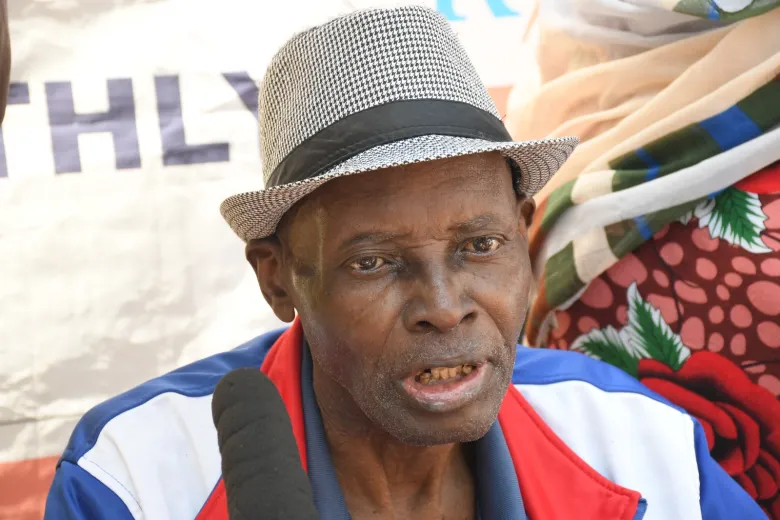
Gor Mahia FC is mourning the death of former player Abbey Nasur, popularly known as ‘Ataba Mario’, who passed away on Tuesday at 8:30pm. He will be laid to rest on Wednesday in accordance with Muslim rites.
Ataba, born in 1952, was one of the most feared wingers-turned-strikers to ever don the green and white jersey during the early 1980s, an era widely regarded as among the most successful in Gor Mahia’s history. Renowned for his blistering pace, direct running and eye for goal, he played a pivotal role in the club’s domestic dominance and strong continental performances.
A Ugandan by birth, Nasur remains etched in the hearts of Kenyan football fans, particularly the Gor Mahia faithful. His football journey began at Police Children School before progressing to Kololo Secondary School, and later featuring for Naguru-based sides Young Salumbey and Naguru Youth after failing to break into the first team at KCC FC.
His breakthrough came in 1969 during the Independence Cup in Mpigi District, where he scored twice for Naguru Youth against top-flight Prisons FC. The performance earned him a move to the Luzira-based side under British coach Bill Kirkham. Though initially finding opportunities limited, Nasur broke into the starting XI in 1971 and quickly became a key figure, forming one of the league’s most potent attacks.
By 1973, Nasur had established himself as Prisons FC’s poster boy, admired for his goals, work rate and professionalism. In 1977, he finished runner-up in the league’s golden boot race after scoring 23 goals. His career was briefly interrupted in 1975 when he travelled to England for a Prisons-sponsored cadet training course, an absence keenly felt by the club.
The political turmoil following the 1979 war in Uganda forced Nasur to flee to Kenya, where he later returned to football with Maragoli FC before joining Gor Mahia in 1981. At K’Ogalo, he teamed up with fellow Ugandan Timothy Ayiekho in a side that dominated Kenyan football throughout the decade.
Often used as an impact substitute, Ataba built a reputation for delivering decisive moments. His penalty against Djoliba of Mali in the 1980 Africa Champions League secured a memorable 1–0 win, while his late cameo against KCC FC in the 1984 CECAFA Club Championships led to a crucial equaliser.
He went on to win four league titles with Gor Mahia (1983, 1984, 1985 and 1987), two CECAFA Club Championships (1981 and 1985) and the 1987 Africa Cup Winners’ Cup, cementing his status as a club legend.
On the international stage, Nasur enjoyed a distinguished career with the Uganda Cranes. He was part of the teams that won the CECAFA Senior Challenge Cup in 1973, 1976 and 1977, and featured at the Africa Cup of Nations in 1974 and 1978. His contributions included a semi-final goal against Nigeria at the 1978 tournament in Ghana, where Uganda finished runners-up.
After retiring from playing, Nasur turned to coaching, handling several clubs in Kenya—including Gor Mahia, Coffee Board of Kenya, Stima and Impala Aliwatanya—and in Uganda, where he coached KCC FC and Maji FC until 2006.
Beyond football, Ataba remained closely connected to Gor Mahia. In 2001, he served on the TB Rescue Committee, a group of former players and administrators that helped steer the club through a severe financial and administrative crisis, an act widely viewed as a testament to his loyalty.
In a statement, Gor Mahia leadership described him as “a football great, a devoted servant of the club and a patriot of the game whose influence extended beyond his playing days.”
Gor Mahia FC said it has lost a legend whose legacy in green and white will endure, inspiring future generations of players and supporters alike.
